A share from Lynnie Mirvis ! Their group has recorded this tribute and shared it with the JSC!
Thank you Lynnie. Kol haKavod!
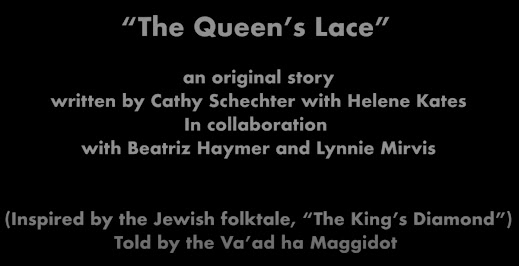

A share from Lynnie Mirvis ! Their group has recorded this tribute and shared it with the JSC!
Thank you Lynnie. Kol haKavod!

TOMORROW AT 6:30 PM ET. SO EXCITING...SET YOUR ALARM NOW!
“A Melody in Israel” – a Chanukah Love Story
By Peninnah Schram
“A Melody in Israel”, an original story by Peninnah Schram, contains historical events intertwined with folklore motifs.
This story, “A Melody in Israell”, was originally published in Peninnah Schram’s book Eight Tales for Eight Nights (that is out-of-print but still available on Amazon.) It is now published in Peninnah’s most recent book Jewish Stories of Love and Marriage: Folktales, Legends and Letters (co-authored with Sandy Eisenberg Sasso) and published by Rowman & Littlefield. (This book is available on Amazon.)
Peninnah Schram audio-recorded one of her Chanukah stories “A Melody in Israel” several years ago when she was invited by Bob Sherman to tell this story on his radio program “Woody’s Children”, that is now heard weekly on WFUV.org – or IF you are in the NYC area you can hear it on WFUV 90.7 FM. THIS year, on Sunday December 13, 2020 this Chanukah program will be heard again (for the 3rd time) between 4-5 p.m. (EST). Bob Sherman has interwoven music for this story to create a ‘cantata’ which takes almost the full hour.
wfuv.org/weekendarchives

Peninnah informs us today that Professor Haya Bar-Itzhak has died. She had been a protege of Dov Noy - and following his tenure at the IFA, she became its Director for about 25 years. She is also the co-author of "The Power of a Tale". May her name be a blessing! Read below for details.
Passing of Prof. Haya Bar-Itzhak
Discussion published by Shalom Berger on Wednesday, October 28, 2020
H-Judaic is deeply saddened to learn of the passing of Prof. Haya Bar-Itzhak (1946-2020), an eminent folklorist and emeritus chair of Hebrew and Comparative Literature at the University of Haifa.
Shulamith Z. Berger kindly passed along this news along with the following necrology prepared by Simon Bronner:
It is with a heavy heart that I share the news that eminent folklorist Haya Bar-Itzhak died October 25 at her home in Haifa, Israel. She was born in Berlin, Germany, on August 17, 1946 to Polish Holocaust survivors. After emigration to Israel, she received her bachelor's and master's degrees from the University of Haifa and finished her Ph.D. in 1987 at Hebrew University of Jerusalem with a dissertation on "The 'Saints' Legend' as a Genre in Jewish Folk Literature" under the supervision of Professor Dov Noy. She returned to the University of Haifa as a professor and in 1992, became chair of the Department of Hebrew and Comparative Literature and in 1994, head of folklore studies and the Israel Folktale Archives. She also held visiting professorships at Indiana University, University of Michigan, Penn State University, University of Pennsylvania, and the University of California, Berkeley. In addition, she was a fellow of the Simon Dubnow Institute in Leipzig.
Her research and publications in English and Hebrew earned her renown globally for work in Jewish folk narrative, history of ethnography in Israel and Europe, ethnopoetics, and women's folklore. Her authored books in English include Jewish Poland--Legends of Origin (Wayne State University Press, 2001), Israeli Folk Narratives: Settlement, Immigration, Ethnicity (Wayne State University, 2005), and with Aliza Shenhar, Jewish Moroccan Folk Narratives from Israel (Wayne State University Press, 1993). Her edited books include Encyclopedia of Jewish Folklore and Traditions, 2 vols. (M.E. Sharpe, 2013), Pioneers of Jewish Ethnography and Folkloristics in Eastern Europe (Scientific Research Center of the Academy of Science and Arts, 2010), and with Idit Pintel-Ginsberg, The Power of A Tale (Wayne State University Press, 2019). In Hebrew, she edited Folklore and Ideology: Studies Dedicated to Prof. Aliza Shenhar (University of Haifa, 2014), Legends of Poland: Ethnopoetics and Legendary Chronicles (Sifriyat Poalim, 1996), and with Aliza Shenhar, Folktales from Beth-She'an (University of Haifa, 1981). She also was the editor of the journals Chuliyot: Journal of Yiddish Culture and Dappim: Journal of Literary Research. She served on the editorial boards of the Jewish Cultural Studies book series (Littman Library of Jewish Civilization), Raphael Patai Series on Folklore and Anthropology (Wayne State University Press), Cultural Analysis, Jerusalem Studies in Jewish Folklore, and the Jewish Folklore and Ethnology Review.
Among her honors is selection as an International Fellow of the American Folklore Society, Lerner Foundation for Yiddish Culture Award, and National Jewish Book Award (for Jewish Poland--Legends of Origin). In 2020, her students, colleagues, and admirers presented her with a bilingual festschrift in her honor Masoret Haya, edited by Tsafi Sebba-Elran, Haya Milo, and Idit Pintel-Ginsberg (Pardes Publishing, 2020).
We extend deepest condolences to Prof. Bar-Itzhak's family, colleagues, and students.
Jonathan D. Sarna
Chair, H-Judaic

Review by Sharon Elswit •. November 2, 2020
In 1955, Professor Dov Noy resisted the push for a homogeneous new Israeli society that would downplay the traditions of immigrants from the Diaspora. With a team of his folklore students, he began collecting and preserving stories from newcomers and longtime resident Israelis under the aegis of the Museum of Ethnology and Folklore. Today, the Israel Folklore Archives, holding 24,000 tales in Hebrew, continues its work as part of the University of Haifa. Haya Bar-Itzhak, the longtime director, along with coordinator and researcher Idit Pintel-Ginsberg, celebrated the fiftieth anniversary of the many narrative voices in the archive with the publication of The Power of a Tale in Hebrew in 2008. Now in 2020, shepherded by Professor Dan Ben-Amos, comes the English translation of that jubilee collection.
With voices of fifty-one narrators from twenty-five ethnic groups, forty-one transcribers, and thirty-eight scholars from Israel and the United States, The Power of a Tale toasts the founder of the IFA and honors his memory. The book does not have one particular audience in mind, and not every entry or conversation may offer individual insight or allure, but there is something here for everyone—folklorists, anthropologists, storytellers, academics, psychologists, historians, rabbis, literary and cultural appreciators.
The fifty-three very different stories here represent traditions of Ashkenazi, Sephardic, and Israeli Jews, along with Druze, Bedouins, Christian Arabs, and Muslims. The greatest number of ethnic narratives come from Poland and Morocco. Story genres and themes include legends about place, history, sacred people, and miraculous salvation of Jewish community, plus myths, wonder tales, demon tales, realistic narratives, and moral and cautionary tales.
Reflecting the breadth of the collection, the opening tale from Lithuania about a young woman who escapes marriage to a demon is followed by a set of three short legends from Iraqi, Polish, and Israeli Sephardi cultures about sacred stones in and from the Western Wall. In a surprising Druze tale, the gift fish delivered by a fisherman’s daughter spits tar at the queen; the sheikh advises her to tell the king that if the fish is forced to say why, the queen will be sorry. In other contributions, readers will discover contrasting views on how the village of Tarshiha was named, how the flying camel became a symbol for the international Levant trade fair of the 1920s and ’30s, and a sympathetic story of the baby who became the legendary Carpathian Mountain robber Dobush.
Narratives arrive from many voices and range from four-sentence, outline-like prose to professionally shaped, ready-to-share tales. Some of them may be known to readers: the Ethiopian woman who seeks the hair from a lion’s mustache in order to improve her relationship with her husband; a broken oath made by a woman rescued from a well and witnessed by a weasel; and the triumph of a riddle-solving daughter over the stubborn arrogance of her husband, the king. But most will be new to English readers. Others, like the Moroccan version of Rapunzel, demonstrate how stories jump across cultures.
Myriad approaches to commentary abound in the essays. These include Esther Scheely-Newman’s feminist analysis of the positive female protagonist in “Mother’s Gift Is Better Than Father’s Gift” and Peninnah Schram’s discussion of the place of riddles in Jewish oral tradition in “The King and the Old Woodcutter.” Other scholars have analyzed the tales they chose by their deep structure and psychic implications. Many explain customs, geographical locales, and story sources. Some read more smoothly in English than others. Extensive bibliographies and notes support their interpretations.
In the simple story of a Polish immigrant’s encounter with a snake across the threshold of his rural settlement house, the recent director finds a universal truth about how resourceful newcomers make use of whatever is at hand to come to terms with their new worlds by turning “chaos into cosmos.” In the simple story of a Polish immigrant’s encounter with a snake across the threshold of his rural settlement house, the recent director finds universal truth about how resourceful newcomers make use of whatever is at hand to come to terms with their new worlds by turning “chaos into cosmos.” So it is with The Power of a Tale itself. The multitude of voices here tell, present, and analyze fifty years of stories from various perspectives. From “chaos into cosmos”— the collection challenges and excites, bringing the reader to a new home.
Sharon Elswit, author of The Jewish Story Finder, now resides in San Francisco, where she has been helping students visiting 826 Valencia locations around the city to write stories and poems and getting adults up and retelling Jewish folktales to share with their own spin.


